Wednesday, June 29, 2011

Planning to Save Civilisation?


The highly polluted waterway between two oil refineries flows directly into the ocean 10km south of Durban. To the right is the SAPREF refinery. Mondi Paper operates next to the two refineries. Between the three pollution both in the air and water has seriously affected the health of many nearby residents.


Durban, South Africa. I made a television program last year about how high-tech their dump is, you can watch that here. However, their regulatory infrastructure for emissions and industrial waste is poor at best, and maybe criminal at worst. With the capability the city has shown at their landfills, it is surprising that they are unable to enforce laws on pollution. If a city like Durban cannot change it’s dirty habits, what chance do the other developed and developing countries of the world have? The world's politicians and activists are coming here to debate just that.

This story I shot with the LA Times shows how children and babies living near the Sasol, Petro SA and Mondi plants south of the city have debilitating heart and lung problems. The sea is so polluted that hazard levels for industrial and chemical wastes exist for fifty miles south of the city. Perhaps it is fitting that the world will gather through this smokey-stinky veil in five-month’s time to discuss how we are going to save the planet.

So how are we?
I am getting excerpts from World On The Edge on my email. It’s a fascinating read by futurist and thinker Lester Brown. I just ordered the whole book, and look forward to getting in to it. This is a man that has continually mapped a changing plan for the continuation of our species, and the chances we have of making it. Far from being a “chicken little” running around shouting that the sky is falling, Brown is a level-headed realist with some great numbers and ideas about how we can make our lives easier, cleaner, more healthy and save the planet all at the same time.

His Plan B series is worth checking out if you, like me, sometimes wonder how we will fix everything that we need to. It really is a Plan B, and that is very important. My brother made shirts this year from some signs I photographed, and it says There Is No Planet B. Well thankfully there is a Plan B, and Brown’s most pressing arguments and plans really provide a snapshot of where we are in the current climate and pollution crisis and where we need to be going, with tangible things we can do to get us there.

So where are we and how are we getting there?
It is vital that governments work now on the beginnings of an agreement to ratify at the Durban Climate Conference in November to December this year. Right now the framework of a new binding agreement to reduce pollutive greenhouse gases should be taking shape, one that takes the place of the Kyoto Protocol. However, large utility companies in both the US and Europe are helping to stymie progress, hoping to keep a business-as-usual approach to regulation and reduction. Some of them wield great power within the committees and discussions taking place at a mid to high political level and the South African press reports that they are using that power to prevent early drafting of real emissions targets that can be met.

There is also much posturing by China, vilified in Copenhagen for their obstinate stance on emissions reductions, and evidence that they will use their new-found friends in Africa (where they have been investing heavily) to help push for a weak deal, or no deal at all. That this would hurt the countries of southern Africa the most seems irrelevant within the political arena..

This is all to be expected. But true courage and the possibilities of a deal are never to be completely discounted. The talks are happening this year in South Africa, a place where dreams do seem to come true sometimes. Trevor Manuel ran the National Reserve Bank and the Tax system of the country, and helped mediate the end of apartheid for the ANC. He is deemed by many to be the best man for the job of making sure that the Durban Conference is a success. He has his work cut out for him.

South Africa as flag bearer?
South Africa is not leading from the front on climate change. If the west was hoping that South Africa would adopt a hard line in favor of strong action to reduce carbon emissions, they may be in for a surprise. In the last week South Africa ended the green tariff subsidy for power that is generated without emissions, nipping a promising incentive for green energy in the bud.


Thembeka Duba, 20 She lives next to the Sappi Paper mill, about 40 km south of Durban, and blames the mill for her Asthma, where she is standing is just 500 Meters from her front door, with the paper mill in the background.

The country also seems intent on nuclear power, ignoring all the bad news out of Japan and forging ahead with plans for a second nuclear power station in the country. They are also planning on building lots of new coal-fired power stations, one of the main greenhouse gas culprits. These actions are the antithesis of the original draft of the Kyoto Protocol, which sought to provide incentives to developing countries like South Africa to evolve along a lower-carbon path, reliant and successful in implementing the new power technologies of the future.

Tit For Tat
However, there is a game that could be getting played here. If South Africa plans all these coal fired power stations, and then does not build them, they can get emissions credits from not building them. The new systems and more importantly the companies that build the green technology alternatives would be financed by the first world’s carbon markets. South African companies, doubtless some of them owned by government and the people in government, would get free or very cheap alternative energy infrastructure. This could be a sort of blackmail that the South Africans and other countries (most obviously China again) will use to leverage out money from developed nations to pay for new clean electrical infrastructure, and also stop themselves from having to reduce their own carbon emissions.

There is also a large component of any new climate agreement that sees billions of dollars in support for countries like South Africa to "adapt" to climate change. South Africa sits in a group of countries that have the least capital and the most exposure to the catastrophes associated with climate events.


Rennee Smith, 26 stands defiantly in front of the Engen Oil Refinery in South Durban, a few blocks from her apartment where she lives with her mother and her young son Kyrone. She blames the refinery for the failure of Kyrone's lungs when he was just 6 weeks old.

Just Posturing?
It could also not be some sort of posturing or plan. Scarily the country may just be that behind and fail to see how great being a renewable energy leader in the world could be. In World On The Edge and his other books, Lester Brown tracks how investing in clean energy technology can boost a country's GDP and bring long term growth through both intellectual and regular capital inflows.

Drop into this mix my earlier blog post about "Fracking The Karoo", a new plan to extract coal bed methane from the last virgin area of the country and that in two years radioactive mine water polluted with heavy metals may reach ground level in the entire city of Johannesburg, then perhaps this land of promise is not the best place to host a meeting of this kind.

At least the delegates who attend will not be able to avert their gaze from the polluted haze of Durban every day. Maybe that will help focus their intent on the task at hand.


A view from one hotel where delegates to the next UNFCCC Conference (COP17) will stay. Pretty to look at but you would not want to swim here: Chromium, zinc, lithium, lead, arsenic, and e coli levels 1000 times the WHO standard, these are just a some of the stew of pollutants flowing into the Durban seafront.

Thursday, June 16, 2011

Chemicals Be Gone: A Sustainable Answer To A Changing Climate


Daniel Kampani's field with his compost heap and his maize stalks protecting the soils where another crop will grow with the coming rains.


“With conservation agriculture, we need less rain”. Says Daniel Kampani, 48, who is farming in the hills west of Lilongwe, Malawi. He has been using fertilizer and planting his small plot next to his one bedroom house for ten years, and each year only managed to get about three hundred pounds of maize from it. Two years ago he stopped using the expensive fertilizer and started mulching the field, using last year’s maize stalks and other plant compost as fertilizer. He lay the fertilizer right across the field, sheltering it from the sun and rain. This year he managed to harvest seven hundred pounds of maize from that plot. Because of this technique, the field also needs less moisture, something that is becoming harder and harder to find.


Daniel Kampani with his wife Clara. The two stand in front of their first big peanut harvest, which is going to bring in enough money to buy more pigs and send their children to school. In the past their tobacco crop barely gave them enough cash to buy basic foods they could not grow.

A farmer like Daniel understands all too well the effects of a changing climate. “We are doing this because of climate change”, he says as he stands next to his wife, Clara who helps farm their land, “here we have had less and less rainfall every year, and when it does come, it rains very hard, but for a shorter time.”

Daniel and Clara are part of a new trend in Malawi. They are members of NASFAM, the National Smallholder Farmers’ Association. This group is seeking to change old habits among the roughly seven million smallholder farmers in this country of thirteen million people. 85% of all the farmers in the country are subsistence farmers, that means they eat pretty much everything they produce. There is only one short growing season, from December to March and after smallholders consume their produce, they struggle to get through what some call the “hunger season”. This is the three months when the rains have come but the new food has not been harvested yet.

The country is small and has a limited amount of land, and that means Malawian farmers must make the most of it. But deeply ingrained agricultural habits have led to severe soil depletion. The people here believe that if they burn their fields in the long dry winter it will ensure a healthy crop, but this is far from the truth. Not only do the active fires throughout the country contribute to bad health and the release of noxious greenhouse gases, but the technique depletes the soils, kills healthy earthworms, and reduces crop yields dramatically. So why would people here do this?


Bumper harvests like this peanut harvest have been made possible through sustainable agricultural practices spread through NASFAM with support by Irish Aid in Malawi.

“They do not have the information that we do”, explains Daniel, “we are trying to get everyone in this area to stop this, but it is hard, it is a traditional thing. We must return humous to the soil, we must make it healthy again.” NASFAM has grouped together small farmers and gotten them to support each other in this new green revolution. As a group the farmers help each other and trade know-how. NASFAM has also helped them to diversify into peanut production, getting small buying stations out into rural areas where they can get a fair price for their produce, without having to truck it to town.

The peanuts replace tobacco as the smallholders’ cash crop, and are a great change for a diet that was very protein and vitamin poor. Legumes like peanuts help replenish nitrogen in the soil after years of maize and tobacco production and their shells make excellent fertilizer.

Irish Aid, the assistance arm of the Irish government, actively assists NASFAM with half a million euros to keep their outreach programs running. Networks of volunteers like Daniel and Clara help spread the conservation agriculture message into remote rural areas. In just a few years they have managed to lift about twenty percent of the farmers in the area out of subsistence farming and into the cash economy.

Deforestation in Malawi is acute, only eight percent of the trees are still standing, and many experts agree that the loss of forest cover contributes to local climate changes. Farmers like Daniel know this all too well, “We also need to plant trees. We need them for fuel, we need them for shade, we need them for fruit, some of them our animals can eat the leaves of in the dry season... they assist in so many ways.”

Daniel now has money to raise pigs, food in his granary, and sells his peanuts on the international fair trade market. He no longer has to worry if he will make it through the hungry season.

By planting trees, making his harvest more climate change proof, and increasing soil productivity, farmers like Daniel are uplifting poor countries and making a positive contribution to our planet. They can also teach the rest of us a few things about sustainable agriculture in a warming world at a time when agribusinesses have trying to convince everyone that the only way to combat climate change is through their fertilizers, chemicals and pesticides.

In Malawi and the rest of southern Africa there is an urgent need for projects of this type. As poor countries cry out in international forums for financing to adapt to the climate change wrought by the rich western world, it is programs like this that should be held up as an example for everyone to follow. But while countries like Ireland and the United States struggle to keep their own economies afloat, small inputs like the one keeping NASFAM running are in danger of disappearing. That would be a crisis for Malawi, and a great loss to our collective ability to adapt to the changing world around us.


Something to sing about: A women's farming group from NASFAM get together to share peanut growing secrets and support each other's new conservation farming practices.

Wednesday, June 8, 2011

Don't Frack With Africa


Flowers in the springtime near Karoo-Tankwa National Park. The fragile desert ecosystem, including this very area of the Karoo, is under threat from oil companies

Most people around the world, particularly in the United States, know what hydraulic fracturing is: shooting a crude and secret mixture of chemicals and water deep into a shale deposit to break up the rock and release the trapped natural gas.

The process needs millions liters of water mixed with an unknown blend of chemicals including (but not limited to) benzene, toluene, ethyl benzene, xylene, ethylene glycol (antifreeze), diesel fuel, naphthalene (moth ball) compounds, boric acid, arsenic, poly nuclear organic hydrocarbons, and other carcinogenic and toxic compounds.

For a great primer on hydraulic fracturing (called fracking) and what it has done to rural communities across America, particularly in my home in western Colorado, see my fellow videojournalist Josh Fox present his award winning documentary Gasland. It is a must-see for anyone who cares about clean drinking water, clean air, justice, and the human story behind fracking.

To Frack or Not to Frack?

Here in South Africa this year a debate has been raging across the country's last pristine environment, the Karoo Desert. An unlikely alliance of farmers, civil society organizations, foreign royalty and local environmental activists managed in April to get Mineral Resources Minister Joyce Shabangu to call for a moratorium on all shale gas exploration while her office conducts a comprehensive study on the process.

The players are the typical mixture of well-funded oil companies. Shell is the most high profile, but US based Falcon Oil and Gas and South Africa's Sasol have also been granted concessions to explore. As it stands today, no one has fracked yet, but in a recent public meeting with farmers Shell's hired representative Tisha Greyling of Golder Associates said, "If its not Shell, it will be someone else".

This sense of complete dominance is scary, even more so for someone like me, who has followed the fight to prevent more than three thousand gas wells being drilled in Garfield County where the Colorado River runs. If well-funded Americans could not keep these corporations out of their own back yards what chance do Africans have on a continent where money always talks the loudest? But there is a growing worldwide anger at these companies and a gathering wealth of information which is starting to wake consumers up to the destruction being done in their name. See Fracking Hell, The Untold Story on LinkTV here.

The Karoo Desert of South Africa is an ancient ecosystem with a vast and poorly understood groundwater system. Without knowing everything about how this water system works, it is impossible to say with any certainty that fracking there would be safe. Shell's proposed prospecting area includes about 100000km² of South Africa's arid heartland, and they have suggested they will blast seawater into the wells with the toxic slurry because the millions of liters of fresh water needed for the process would be too difficult to find in the desert.

The entire area subsists only on sub-surface water. There are no rivers, so almost every drop for drinking, irrigation and livestock is pulled up out of the ground. There is also the very real danger of radioactive pollution, since much of the Karoo has uranium in the ground. The long term impact of shooting toxic sludge into the ground is completely unknown, and any suggestions to the contrary are not based on facts writes researcher Glen Ashton.

South African billionaire mining magnate Johann Rupert and Princess Irene of the Netherlands both own farms in the region and have joined forces to fight Shell's plan to frack in the Karoo. Much of the area that Shell has been granted is private land, but the mineral rights are held by the government. This gives the company carte blanche to plow roads into ecologically sensitive areas, commandeer land from private owners, and even sink gas wells in areas that are currently protected. One site in their concession is next to the largest telescope in the Southern Hemisphere, the SALT, at Sutherland. That the government would grant these concessions to the detriment of such national landmarks does not bode well for any suggested oversight they claim they would have once drilling commences.


The Southern Africa Large Telescope (SALT), the biggest one in the southern hemisphere. The area around the telescope, known for it's clear skies and starry nights, may soon become polluted by gas wells.

Get the Frack out of the Karoo
Nevertheless it is not impossible to foresee rational thought finally turning the tide against these companies. The Karoo is just big oil's latest battleground, but everywhere in the world communities and governments are waking up to the potential and real dangers of fracking. Last week an earthquake in Blackpool England brought a stop to fracking there. Across America from a local to a national level the impunity that oil and gas companies have operated under is being gradually eroded away. If communities and powerful individuals around the world stand up together, the Karoo fight for people's basic rights may just end up being the industry's Waterloo.


Get Involved

There are lots of ways to get involved, and even if you aren't in South Africa, this is a worldwide fight.

Sign the petition on the Petition Site here..

Have you experienced fracking? Been a victim of gas exploration and production activities? Then the Minister should hear directly from you.
Address:
Susan Shabangu, Minister of Mineral Resources of the Republic of South Africa
Private Bag X463
Pretoria 0001
RSA

Write to Shell, tell them you won't buy their products, ever, because of their activities in the Karoo. Then take your business elsewhere. Here is their address:
Shell headquarters
Carel van Bylandtlaan 16,
2596 HR The Hague, The Netherlands
Postal address:
PO box 162, 2501 AN The Hague, The Netherlands
Tel. +31 70 377 9111
Or email them here: royaldutchshell.shareholders@shell.com


Marginal farmlands like this in South Africa's Eastern Cape are totally dependent upon irrigation from groundwater supplies, and the most sensitive to Fracking.

Friday, May 27, 2011

Into The Wild Future of the KAZA Park


This picture embodies the essence of the Okavango for me: Forging a future for the area that sees communities of people and nature working together for a common good.


Our Camp just after sunset under the Jackleberry Tree deep in the Okavango Delta.


We made it into the Wild once again.

The northern heart of the Okavango Delta is a wilderness of papyrus and grass dotted with small islands. During high water, like there is now, the islands shrink and the animals are pressured into smaller areas, becoming more crowded. The larger islands are to the south of us, and most of the larger predators have followed their prey species there.

Journal:
I was just awakened by the odd sawing sound of a leopard prowling around our camp under the Jackleberry tree.

We cleared the area under the tree yesterday of all the elephant dung that had accumulated here since Max camped here a year or so ago. As we were cleaning his loo, so to speak, a large old bull came walking through the water towards us, veering off as he realized his favorite poo-ing spot was taken up by a bunch of pesky two legged critters.

We followed him in the Makoro canoes, listening as his powerful legs surged loudly through the water near us. We beached the canoes once he was up on the island and carried on foot. Tracking a large bull elephant on foot on a small island is not difficult but does have its obvious dangers. Seeing wildlife from the safety of a big metal vehicle is all well and good but there is nothing like walking up to them on African soil, an appropriate surge of adrenaline in the veins, and a clear eye out for an escape route.

Its time to get up. Dawn has arrived and our biological clocks have long been reset to the natural rhythm of the night and day. I have been recording the dawn chorus of birdlife on my sound machine, and although I missed the leopard sounds, maybe I will catch them tomorrow morning if he is back.


We are in the Jakotsha Communal Trust lands on the far western edge of the Moremi Wilderness Reserve. Here there is the possibility of seeing pretty much every large African mammal, as well as a bewildering array of birdlife, snakes, insects and of course lots and lots of trees.


Max, our guide, said this was grass snake but it looks remarkably like a Green Mamba that I filmed in Mozambique last year (LINK HERE).

Our second day in the heart of this vast wilderness started with this journal entry, and we went for a nice long walk in the morning to scout out the island.

The island is about a mile long and half a mile wide, covered with trees and shrubs, and dominated by the magnificent Baobabs.

Baobabs are an amazing tree species. They store water in their trunks, swelling during the rains and then shrinking during the long dry season, looking old and wrinkled by the end of it. They resemble an upside down tree with the roots sticking upwards. Their bark is shiny, and in a further backwards way, they blossom during the dry season and often shed their leaves during the rains, unlike virtually any other green growing thing in the region. Towering above most other trees they are an unmistakable symbol of Africa. Fortunately for them, their wood is useless for building and fire making. Its more like a stringy fiber. This fiber was used for thousands of years by Africans to make surprisingly strong and soft fabrics. The trees were harvested while standing, then regrew their skin. Many old giants still bear the scars of this sustainable use, but there are other reasons for those scars too.


The author in an ancient Baobab Tree, scarred by elephants and hollowed by time, which served as a shelter from two large bull elephants.

Baobab trees are an important part of most southern African ecosystems and here it is possible to see the ancient role they played in the wild cycle of the African bush. They provide a soft fibrous food with high water content for elephants, especially during the long dry season. In areas of Africa where the elephant has long disappeared the scars they left on the many old baobabs can be seen centuries later. Their fruit is edible, and has a high level of vitamin C. The oil from their seeds is widely appreciated in the cosmetics industry today for its moisturizing properties, and many forest communities have started preserving their baobabs and selling the fruit to international buyers. The elephants and many other animals are clearly the big beneficiaries of this abundance in the Okavango, the hard shells of the fruits are scattered everywhere, cracked open and looted for their treasure.


Baobab Trees, like the elephants that feed on them, are pillars of the Okavango Delta's Ecosystem.

We took refuge inside an old Baobab while two large old bull elephants passed nearby, and this was not an isolated use. In Mozambique and Zimbabwe I have seen many big old Baobabs used as places of refuge from marauding armies and animals alike. People have built bars and cafes into the big ancient trunks, and there is a local belief in Malawi that the trees harbor the spirits of the ancestors who sheltered under their boughs in ages gone by.

Our days were full in the Delta. We traveled to nearby islands for walking safaris with Max, who showed us local salts, how to harvest waterlily blossoms, how to use the stems of the plant for a filtering drinking straw, and where to catch a safe swim... safe at least from everything except leeches.

Carl liked eating the succulent inner stalks of the papyrus that tickled our faces as we swept by the in the fiberglass Makoros, but the little sand fleas liked eating him more. He bore the bites for two weeks after our trips, hundreds of them on each leg that drove him nearly mad with the itching. Clearly he was tastier than Martin and I, who did not get bitten by anything other than the odd leech and sole mosquito.


The cycle of life: Carl eats the Papyrus that house the bugs that ate Carl.

The protection this place receives today is clearly not sufficient for it's long-term survival. There is virtually no government oversight. There are signs of poaching, overfishing and unsustainable timber harvesting. Max and the other community members we talked to all agree that the creation of the KAZA (Kavango Zambezi Trans-frontier Conservation Area) is an important step in the preserving the area. Max would like to see permit systems developed that are more enforced, community protection units formed that patrol the area, and a stronger central trust system with real power to protect their natural heritage.

Clearly the community trust system in Botswana has been working up to a point, where communities feel ownership over their resources, and want to preserve them. I was surprised and heartened to hear not only that Max and the other guides support these initiatives that are supposed to be part of the larger park plan, but that they had their own ideas that went even further.

Sitting under the big shady Jackleberry tree during one of our last days in the Delta, Max explained: "We are the only ones who can look after this place, and we need to make sure we benefit from the use of it, then the people will stop poaching the fish and animals." The wind blew lightly, bringing the essence of the Okavango with it. "Five years ago, we would have seen lots of fishermen here, that has been stopped by us, without Geoff Randall's Makoro Project, this very tree would have been cut already...We can make a difference here, and we will make more of one in the future with help and better organization, -we know we can do it, who else will?"

The long trip out of the Delta took us two days, and we made it back to my Landcruiser, the Hog, without any trouble. But that pesky old clutch barely got us to Windhoek, Namibia where Carl and I, together the help of the high-lift jack at Wild Dog Safaris lifted the truck and changed the clutch. Sparing you all the gruesome details, eleven hours later with our friendship still intact, we had the clutch replaced, the gearbox back in, and the truck rolling again. I said goodbye to Carl and Martin, two of the best partners ever, and picked up a new crew for two weeks into the wild and wet river valleys of Namibia.


Max, right, poles us through the Hippo Pools at sunset into the heart of the Okavango Delta.


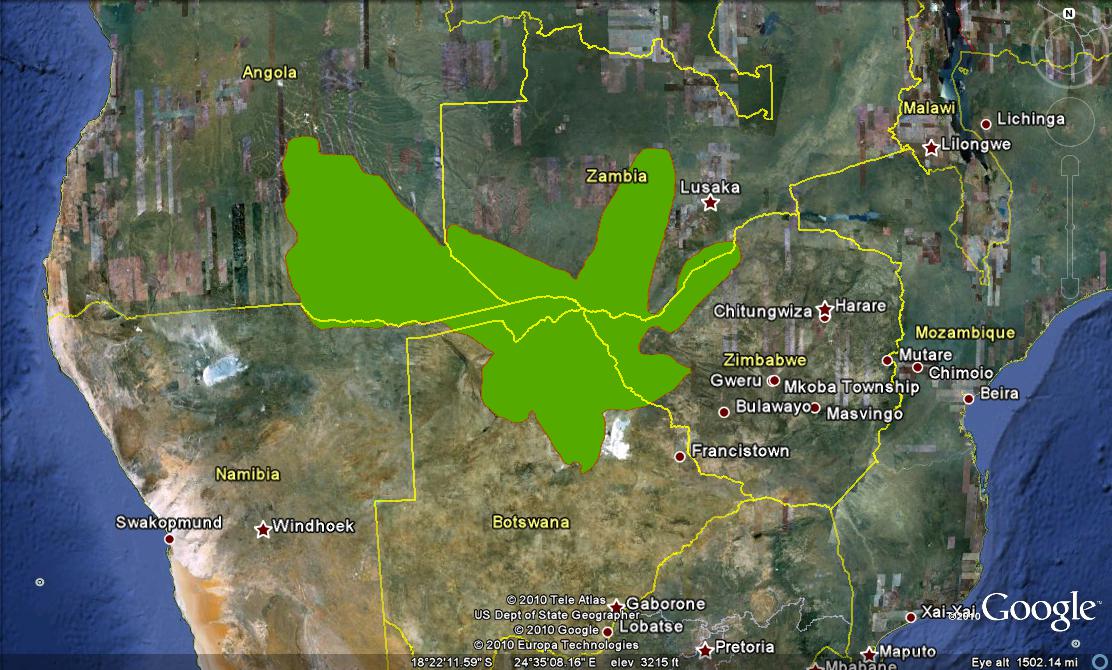
The proposed KAZA park plan.
John Barbee, my father, who is a constant source of inspiration and motivation suggested I put in a map of the park so everyone could visualize what this protected area bigger than Italy will look like.


Postscript:
The Documentary that our team has been making on the KAZA park will be shown later in 2011 on LinkTV.

Thursday, May 19, 2011

The Okavango Delta - Inspiration and Motivation

click on them to enlarge the photos


Driving through the floodwaters with a bad clutch to the place we will leave the Hog and start our transfer to Nguma Island Lodge in the Okavango Delta.


Loading up the canoes and boats for our first transfer. We then unloaded onto one of the lodge's trucks, drove about four miles, then loaded everything back onto more Mokoros for the final leg to the camp.


Martin and Carl's first-ever time on a Mokoro, Carl's shirt reads: "The Kalamari Dessert" in spray paint.

Into the Delta.

The Okavango Delta is a symbol of the types of problems and successes facing the future of the proposed Kavango/Zambezi (KAZA) transfrontier peace park. This vast area is one of the largest inland deltas in the world, the largest swamp in the southerm hemisphere, and the numbers help tell the story. The Okavango Delta fluctuates between 6, 000 to 8,000 square kilometers during the dry season, swelling to 15,850 square kms during the flood, which is happening now.

The Kavango River flows from the Angolan highlands 1100 kilometers away, then through Namibia and out onto Botswana’s Kalahari Desert in a huge alluvial fan. It never reaches the sea, but languishes in the hot dry air creating an unique habitat for an amazing array of birds, plants and wildlife. There are 150,000 little islands dotting the Delta, which get bigger or smaller depending on the time of the season.

Only a small part of the Delta is actually protected by a designated National Park. Moremi National Park is in the central northeast of the Delta, and with Chobe National Park to the west, covers about a third of the Delta’s area. The rest is not totally unprotected, but maintained by a community concession type of system that allows mixed use of the land, isles and wildlife. Some of these activities include hunting, fishing, and even wood cutting.


Our last transfer to Nguma Island and the first time we meet Max, left, who became our guide and dear friend over the next five days.

The future of the Delta is in doubt. These are desert countries, and this is a lot of water. There have been many plans to divert or utilize the flow of the Kavango River which would dramatically change the nature of this dynamic system. One of the reasons behind the creation of the KAZA is to protect this ecosystem, and make it work for the communities that live along side of it. That means that community concessions must play a vital role in protecting it, probably a bigger role than they are playing now.

Our trip combines elements of community conservation systems, private lodges, and local people who will guide us through this fascinating place.

Nookie and Jeff Randall started Nguma Island Lodge years ago in the upper northwestern part of the Delta, near the town of Gumare. They bring in tourists during the high water season with a series of boat and truck transfers that really create a feeling of isolation. Their gorgeous lodge rests on the edge of Nguma lagoon, and they cater for tourists of all sorts, even campers like us.

They also enjoy a successful public-private partnership with the local Jakotsha Community Trust, who run the NG 24 Concession in this part of the Okavango Delta. The polers they employ all come from the local community, and far from being simple men who push a boat, these guides are encyclopedias of knowledge about the animals, plants and issues affecting the Delta.

Geoff, Nookie’s husband sadly passed away a few years ago, but some of the projects he started live on. An avid outdoors-man with a love for nature, he saw that increased tourism for the Delta was difficult for one very obvious and important reason. The boats, called mokoros, that people use to get around in the thick reeds are long, and thin, and traditionally made from big hardwood trees.

The delta is a swamp dotted with islands, and on these islands are a limited number of trees, but the number of tourists wanting to see the Delta is increasing exponentially. So the people of the communities were cutting down old trees that anchored the islands in the shifting waters, and using them to make boats that lasted about three years. This was clearly unsustainable, and after many attempts to get government oversight onto the problem, Randall and his team of local guides had an epiphany, why not make replica boats out of fibreglass?

And so began a period of experimentation in making makoros that look and feel like wood, but are lighter, stronger, and far more durable that the wooden ones that were made traditionally. His final product is a masterpiece of innovation and appropriate technology that has changed the face of transport in the Okavango Delta, and probably saved thousands of vital trees. Their lifespan is unlimited, since they can be fixed simply, and they are perfectly water-tight, so the bums of high-dollar tourists don’t get damp while out on a makoro safari. They are easier to pole as well and can carry a much higher payload, with a minimum of effort.

Before my readers start to talk about the environmental impact of using polymer and glass-based fibre systems, keep in mind that two well-ventilated and well maintained shops can and did supply virtually the whole Delta with these mokoros, and if Nookie has her way, they will again. Geoff fixed any fiberglass mokoro for free if someone brought one in, essentially guaranteeing them for life.

Matshelo (Max) Thokabotshabelo has been poling the waters of the Okavango since he could walk. He and all the other polers I spoke to agreed that Geoff Randall’s mokoros are the most sought after things in the Delta. Sometimes their own boats are even stolen the demand for them is so high. Standing under a gorgeous Jackleberry tree, Max maintained that without Geoff’s boats, trees like this would be a thing of the past, “The people would have taken down this tree years ago if it wasn’t for Geoff and Nookie, everyone now wants a fibreglass Mokoro, and that is good for our trees”.

It is a rare look at a can-do project in Africa that works, and something that the KAZA program coordinators should look at for inspiration.


Our bushcamp, with the tent where I wrote the journal entry at the end of this story in the middle of the frame behind Carl and Martin.


We woke up this morning on Nguma island in our little bush camp near the main lodge, The guys are outside my tent getting our things packed and ready to board a boat with three of Geoff’s fiberglass canoes on it. We will get transferred into the northern part of the Delta for a three day trip with the local community guides from the Jakotsha Trust. Hopefully we will get out there, wont get stung by any more bees, and come back with a pile a memories and new experiences. The birds are singing a loud dawn chorus and I am excited about everything. It is days like this that make doing this job ever-so worth it. Nothing to worry about except the nature around us, where we will camp, whether we have enough food, how our beer supplies are doing. This is the basics, the things humanity evolved worrying about. Far from cellphones, unit trusts, bills and everything that makes us forget that we are just animals living on borrowed time, on a borrowed land.


Sunset over Nguma Lagoon from our bushcamp near Nookie and Geoff Randall's Nguma Island Lodge.

Sunday, May 15, 2011

Out of the Pans, Into The Fire


Martin at Jack's Camp.


On our last day in the Pans, sitting back next to the fire at our little bush camp, we poured some hot coffee and waited for the sun to go down so we could walk to the brush covered hill overlooking a wet spot in the pans and maybe see some game at sunset. It had been a gorgeous day, not much driving, and lots of bird watching. We had seen some spoonbills and a group of dozens of young Lappetfaced Vultures, as well as many others. The three of us had bonded over the last few days and were looking forward to being in the Okavango Delta. For Martin and Carl it would be the first time, and they had no idea what to expect.

Martin sat forward in his camp chair, and smilingly slapped his leg, "ouch!" another bite of something small...then he saw it was a strange type of bee. He laughed a bit, said good thing he wasn't allergic, pried out the stinger and thought not much more about it. Fifteen minutes later the aggressive poison had raised huge welts, and fifteen minutes after that it became clear he was indeed having his first allergic reaction to a bee sting.

I had carelessly given away my antihistamines two weeks earlier in Cape Town, and not thought to replenish them. I am not allergic to anything and both Martin and Carl thought the same. Even the most well prepared expedition can come up short, however, and now we were in what could be very serious trouble. We were at least two hours hard driving from the nearest clinic, and maybe more. Fortunately we were near Jack's Camp, one of the oldest bushcamps in the Magadigadi Pans, and a five-star fly-in safari destination of some repute. I felt confident that they would have oral and inject-able solutions to Martin's increasingly perilous condition.

Leaving Carl at the camp, we jumped into the truck and I made all safe haste for Jack's, about six miles away. By the time we arrived Martin was struggling but still on his own feet, and within five minutes he had antihistamines in his body. The young but capable staff had a doctor on the radio, and in case of need a medical evacuation flight sitting on the dirt runway.

Thankfully within the hour Martin was stabilized and looking much much better. We arrived back at our camp just after sunset, to a great reception from Carl who had been very worried. There are now both inject-able and oral antihistamines in my medical kit, and from now on they will be fresh and available for future need.

This is a clear illustration of some of the dangers inherent in being alive in the bush. Most people live within thirty minutes of medical help. Once you go beyond that it is necessary to be prepared for most eventualities. I have a wilderness medical certificate, and Martin is a qualified veterinarian, and both of us thought we were covered, because our past experience showed we were not allergic to bees. I carry an extensive medical kit that will take care of most problems in the bush, at least until we can reach a hospital. Yet we did indeed come up up short. The lesson to learn is: Prepare for every eventuality that you can.

We would both like to extend our heartfelt appreciation for the very professional staff at Jack's Camp and the way that they reacted in such a helpful manner. Martin also should be commended for keeping calm, keeping watch over his symptoms, and remaining positive.

After a rest day in Maun near a critical care facility to make sure Martin was indeed fine, we headed up into the Okavango Delta.

Friday, May 6, 2011

Botswana's Magadigadi Pans and Khubu Island in Pictures


Another Desert Campsite near the Pans.


Lappetfaced Vultures take flight in the Magadigadi National Park in Botswana. The Vultures are an indicator species, and a thriving group of juveniles like this one shows that the ecosystem here is very healthy.


The Granite bedrock of Khubu Island, in the Magadigadi Pans. The Island is still a spiritual center for the both the San Bushmen and the local community.


Travelling across the Pans can be very dangerous in the rainy season. Its best to never leave the main roads, or else you run the rick of slipping into the primordial ooze that lurks beneath the crusty clay.


The Magadigadi Pans National Park, only covers about a third of the pans' area. Here on its Eastern edge our desert campsite, with the Southern Cross on her side above us.


In the shadows of a Baobab Tree, Khubu Island's isolation is ending. This one-time island in a lake is now an island in the vastness of the Pans. It's serenity and beauty draw thousands of tourists a year, who bring in revenue to the local community.