Thursday, May 24, 2012

Our Dynamic Coastline - Success in St Augustine

Smyrna Beach receded into the distance and we made our way up through the long thin canal of the Intracostal waterway, surrounded by bird life and the hanging Spanish moss.  We were headed for one of the oldest towns in the USA,  St Augustine Forida.  This town is known for its ancient fort, built by the spanish, and the alleged site of the fountain of youth, but those are mere side attractions to one of the most amazing festivals in Florida, the annual sea turtle festival. 


The main square in St Augustine is one of the oldest public spaces in the USA.

Katie Jackson of Florida Fish and Wildlife Conservation Commission at the 6th Annual Sea Turtle Festival shows children where the baleen of a whale comes down on her own mouth.


Tara Dodson is the President of Keepers of the Coast, an NGO that supports dialogue between different stakeholders in the community.  As the festival wound down on Sunday she explained that having so many different participants and the full support of the municipality really showed that this coastal community had turned corner and now started to give the natural ocean resources real support and recognition for the "ecosystem service" that they deliver to St. Augustine.

Kati Jackson from the Florida Fish and Wildlife Service sat in front of the baleen jaws of a huge whale, explaining to children and at least one inquisitive journalist how a baleen whale really eats, and why right whales have narrow inlet jaws.  It happens that in fact they are surface feeders and go around hoovering up the phytoplankton that occur on or near the surface of the ocean.  The waters off of Matanzas Bay are the north northern Right Whale's critical breeding habitats, and the huge gentle giants are slowly rebuilding their population here after generations of decline. 

But this was the turtle festival, and here both Loggerhead and Leatherback turtles, the largest in the world, are slowly pulling themselves up the beaches in the darkness of night and painstakingly laying their eggs before dragging themselves back to their watery home.  May is the heavy egg laying season, and we hope to find some of these 800 kilogram creatures over the next few weeks.  Already early one morning near place called Nettle's Island we found a "false crawl" of a loggerhead in the morning, where she had crawled up to the beach but decided to return to the deep before laying her eggs.

With Climate Change, vital turtle habitat will likely be one of the first things to disappear and already there has been a sharp decline in egg laying last year, though no one knows for sure the reason.  This is not true of the festival however.  Six years ago, the first event brought seventy people, but this year more than one thousand five hundred attended.  Slowly people are starting to wake up to the magic of the nature in their own back yards, and that can only be a good thing for people and turtles.

The old entry at the Hotel Ponce De Leon hotel in St Augustine, now a University.


St Augustine Florida.

Friday, May 18, 2012

Mosquito Lagoon


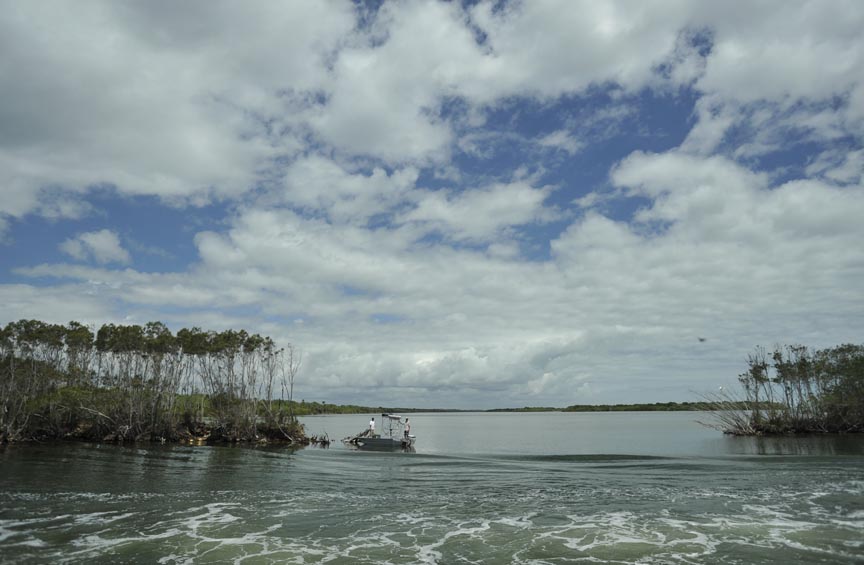
Right now we are sailing up the Intracoastal waterway between the mainland of Florida and the protective barrier islands.  We just left the Indian River Lagoon, and entered into the Mosquito lagoon, just north of the United States spaceport of Cape Canaveral.  Over the last two days we watched the massive complex slowly get ready for a launch of the first private spaceflight in it's history, run by Elon Musk's SpaceX company. 


The entrance to Mosquito Lagoon.  Many fisherman and birds come here to feast upon the abundant fish species that feed on the myriad insects that breed here.


Frances Tisdel at the helm, as we make our way up the Intra-coastal Waterway through Mosquito Lagoon.


Mira Dutschke gets ready to attach our bowline to the mooring buoy so we ride out an intense storm above the lagoon. 

Our New Zealand neighbors at a mooring in the Indian River Estuary, just before a big storm swept in.  This area of Florida has had a terrible drought, but now is experiencing intense storms with hail and massive rainfall.
The New York Times reports that the South African born Musk will be owner of the first ever private launch of a service flight to the International Space Station.  Its funny to look out across this well-preserved place and think of the massive derrick far in the distance that houses this groundbreaking inauguration of a new chapter of America's space flight.  72 hours before the flight the area all around us has become a high-security zone, and we are forbidden from leaving the intracoastal waterway channel to explore deeper into this insect infested wilderness, full of abundant wildlife and some of the best preserved coastline in this low-lying state.

Sailing up the Indian River Lagoon on Florida's East Coast before entering Mosquito Lagoon


The Indian River Lagoon/Mosquito River lagoon complexes are huge and make up 40% of Florida's entire east coast. Like areas further south, here the major danger for the moment from Climate Change seems to be increased runoff from larger storms that deposit large amount of sulphates and nitrogen based fertilizers into the lagoon. This "non-point source" pollution, as Charles Jacoby calls it, comes mostly from homes and farms. 

Already a small crew of the largest deer flies I have ever seen have joined our little expedition, and no doubt the mosquitoes are following them up with a vengance…I can almost hear their winey little voices crying out to us: "come baaaack! Cooooome baaaack! we are waiting for youuuuuuu!".  It has been a narrow escape perhaps, but then there is always tonight, when they may come for us in our bunks.


Mosquito Lagoon is a bird's paradise.  It is also an oyster's paradise, a mosquito's paradise and a rocketship paradise.  That such a breathtakingly beautiful place should so quickly move behind us is a tragedy, especially since we were supposed to meet up with Troy Rice and his team from the Indian River Lagoon National Estuary Program.  We had a great chat with him and project scientist Charles Jacoby in Vero Beach a few days ago when we came through there.  They invited us to join them in Mosquito lagoon yesterday morning where they were working to re-establish oyster beds. Sadly our sailing vessel the Lily Rose just could not get there in time, and our window of opportunity closed with Saturday's launch.


Florida Atlantic University, Harbor Branch from our Camera Kite.
The Lily Rose at anchor at Florida Atlantic University, Harbor Branch.
At a dock for the night in the central part of the Indian River Lagoon.


Tuesday, May 15, 2012

Adventures in a Changing World-Del Ray to Vero Beach

We are currently at our mooring buoy in Vero Beach, Florida, after having made our way up from Del Ray through the Intracoastal Waterway.  Yesterday we were at the Harbor Branch of the Florida Atlantic University, meeting with scientists and learning about the threats that climate change is bringing to Florida. 
Our anchorage at Vero Beach last night.


The team sailing with watermelon.

The author meeting with researcher Nicki Desjardin, who is studying Loggerhead and Leather-back turtles on the Atlantic beach in front of Nettles Island.

Never a good idea...

Dr. Brian Lapointe getting interviewd by the team at Florida Atlantic University

 
Sailing away from Harbor Branch, Florida Atlantic University
The kite camera above the Florida Barrier islands

There are many serious issues, including the loss of fresh water lenses on the Keys of Florida.  These little islands poke southwards form the state, and bring thousands of tourists a year to this low lying coastal area. They are surrounded by coral reefs.  The islands themselves, like many coral islands in the world, have a "lense" of fresh clean water that "floats" on the sea water around it in the porous island coral.  Researchers like Dr. Brian Lapointe are studying how these fresh water lenses are disappearing, mostly due to inundation by rising sea levels caused by Climate Change.  He suggests that sea levels have already risen by as much as a foot (roughly 15 cm) around Florida.

But this is not the most dire of issues.  In Florida, the politically powerful farms that lie just above the world famous Everglades pump millions of tons of fertilizer into their crops, mostly sugarcane.  With Climate Change comes greater rainfall and these increasing flood events cause more runoff into the fragile marine ecosystems around the Florida Keys.  Greater runoff forces these unsustainable farms to pump even more fertilizer onto their land.  In this runoff into the ocean are huge amounts of fertilizers, and these cause algae blooms and over-oxygenation of the water. 

(this post has been corrected on May 25th, 2012): This is not true as my brother John Michael Barbee, who has a masters degree in environmental engineering, points out:  "I noticed in your recent blog that you posted a comment about the fertilizer loading on land that drains into the ocean, causing algal blooms and, eventually, "over-oxygenation".  You seem to imply that over-oxygenation is the problem but it is not--it is the depletion of oxygen that comes from the cycle of algal bloom life and death where bacteria demand oxygen for their own survival when they "eat" the detritus from the algae blooms.  this leads to dead zones where there is not enough dissolved oxygen for life, especially fish, which are the most sensitive, usually hope that clarification is helpful."

My apologies for the confusion and my huge thanks to Mike for pointing this out.
-Jeff Barbee

Dr. Lapointe told us yesterday that maybe only 7% of all the coral in the keys is still clean and healthy.  This has had terrible financial repercussions for the state, local communities and fisherman, who all rely on this valuable resource to provide a living for themselves and their families.

Today we are headed up to Indian River Lagoon, to meet with the Indian River Lagoon National Estuary Program scientists.  They are working at restoring the ecosystems that help clean some of the runoff from the large scale farming in the state before it enters the sea.


Friday, May 11, 2012

Islands Project: Days 1 to 3 - A Photographic Diary

We flew into Miami, and met the Lily Rose and her crew at the MiaMarina docks after a huge Argentinian feast following a nine hour air-journey from Denver Colorado.  We are traveling up through the barrier islands of the US coastal states of Florida and Georgia, following scientists who are working at the forefront of global climate change. 

These coastal islands are the American front line in the world of rising sea levels, and we are here to find out if these changes are already happening and whether this low-lying state is at risk.  We are also here to celebrate some amazing conservation triumphs and some interesting challenges that are only now coming to light.


The Fort Lauderdale Beachfront.  Called the Miracle Mile...for no reason we could discern.

The Sailing ship Lily Rose underway, moving north from Miami to Ft Lauderdale.

One of s series of rather large bridges that must be raised for us to pass through. There may be as many as 20.  It seems at odds with our little sailing ship to be able to hold up bridges and even cars, but it is nevertheless the case.

Miami on our first night.  This huge city's water supply is at risk from rising sea levels.

The Fort Lauderdale area, Los Olas Marina at sunset.


We are sailing today and over the weekend from Del Rey, up through the Intra-coastal Waterway towards Fort Pierce, where we will meet with researchers from the Harbour Branch of Florida Atlantic University. 

Our sailing boat is the 40ft Lily Rose, an Island Packet single-hull sailing ship in the prime of her life.  She is ready for the deep sea, but on this journey we will be staying mostly in the protected waterways of Florida and Georgia, seeking out islands and researchers who can tell us more about how our planet is changing. 

This is the first journey of many where we will be visiting the most exposed places in the world to Climate Change, and we hope to share what we find in photos, stories and films that we are producing as we sail.  Our team consists of Captain Larry Moser, Bob Whitehead, researcher Mira Dutschke, myself and the indomitable Frances Tisdel, chief Cook and Admiral.

The Intracoastal Waterway is mostly man-made, but utilizes may natural features.  There is not much nature in this area here, but as we move northwards, a vast array of parks and protected marine areas will hopefully open up for us.


As you can see from the pictures we have been cruising up through heavily industrialized areas, with lots of different boat traffic and huge bridges that have to be raised for us to pass under.  We are hoping to get up into some conservation areas tonight and spend the night far from lights, under the stars of the Florida spring in a little anchorage surrounded by (dare we hope?!) the Florida Manatee.


The Lily Rose at rest right now, and the lower photo...last night from the same location:  The Del Ray Yacht Club

The Lily Rose, at rest last night on the Intracoastal Waterway.


No matter where we go, we are always followed by this strange, evil looking animal.  We think this may have something to do with climate change, but we are not sure.  I think we will sail as much as possible and try to get away from it...


Sunday, April 22, 2012

Happy Earth Day!

For the last few weeks I had the great pleasure of visiting the southwest of the US.  This region is home to many indigenous peoples, the Hopi, The Navajo, The Ute and and Paiute, and others.  Many of these people trace their lineage back to an ancient people called the Ancestral Puebloans.  These people lived in the southwest for almost ten thousand years, maybe even more.  Their way of life included the construction of some technologically impressive building sites from Mesa Verde in Colorado to Chaco Canyon in New Mexico.

As I hiked over the top of Chaco canyon with a little field guide to the ancient ruins, I got to the top of the hill at a place called Pueblo Alto.  This is the highest dwelling-place the ancients built on this site and it has views across hundreds and hundreds of kilometers to the mountains of Colorado and Utah and even Arizona.  This was the Chacoans ancient realm and scientists believe they have  traced an ancient line-of-site communication system that spanned tens of thousands of square kilometers.  Thin pieces of mica or vermiculite may have been sewn on onto huge round stretched hides and transmitted a morse-code type system, at night they may have used fires.

Around the middle to the end of the 10th century AD, the Chacoan civilization seems to have ended.  No more impressive cliff dwellings or huge settlements, no more wall building, and no more long distance communication. 

Even then this was marginal land.  In the hearths and middens of these ancients are the leftovers of foods stuffs that are still grown in the area.   Perhaps they exhausted their surroundings or were driven off by invaders, but whether environmental or political, their systems disappeared.

The massive roads of paving stones they built have fallen to ruin, but new ones have taken their place.  Around these footprints of the ancients the new world of cars and interstates and cities and 7-11s holds sway.  On this Earth Day, perhaps we should remember the old people, who's lives at the time exuded permanence and solidity, but who's settlements and successes now lie as a warning for us.  What warning or message of hope will we leave?  How can we escape their fate?

I always feel that there is positive message to deliver, and if there is one here it is this:  we now hold the key to our future.  It is clear what we must do, and (to quote the six million dollar man) we have the technology, and we can rebuild ourselves and our shattered ecosystems into what we want them to be.  It is up to each one of us now, and collectively we can leave a legacy that outlasts ourselves and echoes through the generations yet to come. 

It is our decision now.  We have a responsibility, we have the means and the talents to make the hard choices and survive, thrive and show in our works that we can live together with each other and with this Earth. 

Some may baulk, and some may be hopeless, but in fact we have never been more powerful, and that power is both destructive and constructive.  Let us use it the best way we know how.

Happy Earth Day!

Chaco Canyon, the center of the ancestral Puebloan Culture

Camping at Chaco Canyon beneath the stars.  The canyon is not as impressive as other sites from a nature point of view, but the historical relevance and deep cultural history is almost palpable.   This is the most studied archeological site in North America, and a place of deep spiritual significance to the indigenous peoples of the area.

Kin Kletso ruin in Chaco Canyon.

Kin Kletso sits south of the more famous Pueblo Bonito.  The valley was the epicenter of an ancient culture that had trading ties with peoples as far south as the Yucatan Peninsula in Central America.

On the Navajo Reservation in the town of Crown Point, a bi-monthly auction helps local craftspeople sell their unique art to collectors around the world.  This wool rug represents hundreds of hours of work, and sold for 1200 US Dollars. Many historians believe that the main reason Chacoan culture grew so strong was through an integrated trading system.

Early spring clouds hang over Monument Valley in Arizona.  The Ancestral Pueblo people, based out of Chaco canyon, may have communicated regularly with the people here, 480 kilometers away.

Hite, in Utah, is one of the farthest flung parts of the ancient Chacoan world.  Here the sun is embraced by a struggling old juniper stump, still growing possibly from the time of the ancient peoples.

The cadence of the ancient world was determined by the march of the seasons, much like our world today.  At the beginning of spring the sun sets over the Henry mountains in Utah, from the top of which could be seen all the way to Chaco Canyon, 580 kilometers distant.

Venus sets over the desert near Glen Canyon in Utah.  Chaco and many ancient sites in the area are aligned directly to the rising and setting of different stars and the sun and and the moon.  The ancients were aware of the the solstices and equinoxes, and like even our culture today may have given certain seasons, constellations and planets a variety of meanings as clear to them as our horoscope is to us. 

Thursday, April 12, 2012

Creating A Climate For Change- Movie Screenings in April

The Invite for the 19th of April at The Aspen Center for Environmental Studies.    


The Invite for Colorado University at Boulder for the 23rd of April.


Tuesday, March 27, 2012

The Grapes Of Wrath


They sit next to me on the train like an angry accusation, following me through Europe, dogging my steps.  In a week where Time Magazine chose "locavore" chef Rene Redzepi as their front page cover, I have done the unthinkable.  I purchased some South African grapes this morning at the supermarket outside of Frankfurt, Germany. 

These little red seedless "devils" flew to Europe on a chartered aircraft from what is called the "Green Kalahari".  For a few months of the year, the Orange River farms of the Upington Area of South Africa grow and export the only table grapes available throughout the world.  Special 747s and other long-haul aircraft land at an old army base outside this desert town and load up pallets upon pallets of table grapes, jetting them around the world to hungry grape lovers everywhere.


The offending grapes traveled from Upington, South Africa to grocers in Germany.  Simple choices about the foods we eat can make a huge difference, creating a sustainable future for the people of the Earth.

That makes these grapes the antithesis of the locavore movement.  Locavores only eat things that are available within a few hundred kilometers of the place they are consumed.  This helps support local farmers and industries, reduces greenhouse gas emissions from long-haul transport, and is usually cheaper, fresher and tastier. The world's consumers are starting to wake up these facts, and nothing says that better than Rene Redzepi's locavore restaurant Noma being listed as the number one in the world by Restaurant magazine.

But here in Germany the sheer incredible novelty of having a fly-in South African export so cheaply simply shocked me.  They were cheaper by half in Germany than they are in South Africa.

I have been out in the fields where these grapes come from and it is an isolated spot more than 800 kilometers from major markets in South Africa.  The systems that deliver these grapes from there to the urban centers like Johannesburg and Cape Town are also expensive.  The trucks run on poorly maintained single-lane roads, paying petrol prices more than triple the US pump price.   By my thumb-suck number crunching (and hardly dependable), the actual cost of transport in terms of carbon is about half or a third for trucking them from Upington to Johannesburg as it is for flying them from Upington to Frankfurt, Germany.  The carbon cost of flying them across the planet is at least four times that of trucking them. It may be as high as ten times.

Oranges for export to Europe ripen on the tree near greenhouses that grow other vegetables in the town of Citrusdal, South Africa.  The long trip that many of these products make to EU and US markets mean their carbon footprint is many times that of similar local products that are seasonal.
Any reader who would like to help calculate the cost, I bought these grapes in Germany for 1.5 Euros for 500 Grams of grapes. In Johannesburg they are about 2.8 Euros for the same amount.

The table-grape market in Upington and the "Green Kalahari" is the single largest cash earner along this area of the Orange River according to the local chamber of commerce.  In a land with 30% unemployment and few ways to earn an income, a collapse in the industry due to the lack of demand would spell poverty and hardship for hundreds of farms and thousands of farm workers. 

So these well-traveled grapes play a role in a desperately poor economy, but in a world with rapidly rising CO2 levels, and little being done about them, going locavore is something we can all do today to immediately make a difference.  Lack of demand internationally is in fact driving down the international price of grapes from South Africa, though it is hard to know if this demand drop is driven by consumer choice or the world recession.  It is probably a bit of both. 

All this starts to sound complex and untidy for those of us wishing to make a difference today, but the world is complex and untidy and our individual choices need to be as informed as possible.  Is the loss of jobs in South Africa a fair trade off to have less CO2 in the atmosphere?

At the Forest Ferns workshop near Tsitsikamma, South Africa, ladies sort fresh ferns for airline-supported export to Holland.  Thousands of farms across the continenet export tons of fresh produce daily from Africa to foreign markets. Even buying flowers with greenery around them can increase consumer's carbon footprint.


The farms of the Green Kalahari are not living in isolation. Thousands of African farms from Cape Town to Nairobi and beyond fly produce and flowers out of the continent every day.  They bring in valuable foreign exchange and support hundreds of thousands of people with scarce jobs.  The locavore movement, if it catches on like many hope, would spell the end of this vital trade.   Are there other ways the farms of Africa can make money without flying produce around the planet?

Often in this column there are people out there with solutions and I try to share their experiences with readers, but this issue is one we must all chart on our own.  As a journalist, my gut feeling says there must be a middle-way, one which can satisfy people's need for an income with another's need for conscience-driven eating habits. 

In South Africa most people don't eat table grapes, they are far too expensive.  They are more than double the cost of the same grapes in Germany today.  There are few major food industry distributors in South Africa, and they are often cited for cartel-like behavior.  In both Europe and America, large scale shops sell food roughly 20-50%  cheaper than South African retailers in the major cities.

Perhaps the old idea that farms must fly goods that Africans cant afford to wealthy buyers in Europe is itself outdated.  As early as 2004, eight years ago, writer Rory Carroll and I worked on a story for the UK Guardian about the buying power of the rising black middle class in Africa.  So why can't more African farmers make a livelihood by selling their produce in Africa?  In most African countries lack of infrastructure and poor government oversight often contribute to high food prices.  Although these are tough problems, they are surmountable.  Pushing farmers to open up bigger markets at home may be an answer, and there is some data that suggests the rise of Africa's middle class is helping to do this.

As a consumer I am going locavore, knowing that my choice may mean a child somewhere in Africa or elsewhere in the developing world may not be going to school because their father lost his job.  The status quo is not environmentally sustainable and in fact as mentioned above, it may be outdated.

To counter the loss of jobs, I choose to make small cash payments to offset my carbon footprint, creating a new type of job in Africa, one that builds a greener, more sustainable future.  My own choice is a project in South Africa that is close to my heart called Elemental Equity. This company is connected to Living Lands, and the South African Working for Water Program.  They help me become carbon neutral, planting indigenous trees that restore natural landscapes damaged by unsustainable farming practices. They are outlined in one of the chapters of the film Creating A Climate For Change.

Together we as consumers need to chart a new path, one where our choices are driven by our consciences, one where we don't shy away from the hard realities of those choices.  Only by tackling these hard choices head on, and turning our anger or angst into action will we leave these grapes of wrath behind us and build a better future that is more fair to people and the planet.